A few people now have razzed me about putting on the pounds since starting to write daily about food. So I went to the mall to find out how much I weigh.
Yeah, I went to the mall to find out how much I weigh. You wanna make something of it?
Truth be told, I do not own a scale. I've always abhorred the idea of owning a scale. I mean, why do people punish themselves like that? Isn't life cruel enough beyond the threshold of your bathroom? Owning a scale is like owning a handgun: you may need it now and again, but chances are more often than not you're gonna end up regretting putting it to use.
So whenever I want to find out how much I weigh, I go to the mall. I find a store that sells scales and I try 'em out. It's sort of like going to a guitar store.
So this weekend I go to the mall to weigh myself and I make a startling discovery. I weigh 197 lbs. And I weigh 189 lbs. And I weigh 193 lbs.
Huh?
Now, mind you. I'm not standing on some antique twentieth-century spring scale. I'm trying out state-of-the-art digital computer scales with no-slip treads, heated foot-pads, and shock stabilizers. I understand that on the spring scale, I may have to adjust the balance manually before using the scale. I can handle that. The extra work helps me shed a quarter of a pound before setting a foot on the thing.
But on the thermo-ionized-triple-galvanized-heat-seeking digital scale there's nothing to adjust. Which can mean only one thing:
The scale don't work.
Now, really. Are we so vain that we'd prefer living a lie rather than making minor manual adjustments to gain a more accurate picture of reality?
Of course we are. Which is why there were only two of the models which read my weight as 189 pounds and several dozen dusty boxes full of the other scales.
So much for my mall method. Looks like I'm gonna have to run away with a carnival and get my monthly measurements figured by that guy who guesses your age and weight for a buck.
At least if he screws up I'll win a rubber chicken.
Now, the more astute among you will have realized that I've yet to mention anything vaguely related to food. And you would be right. Which brings me to our next paragraph.
This whole faulty scale thing got me thinking about the quality of those digital scales at the deli. I mean, would I really be able to tell the difference between a quarter pound and a half-pound of thin-sliced Muenster cheese without those little LED numbers flashing before my eyes?
I mean what is weight really except something to do with mass and gravity.
And then the big one hit me: the earth's gravitational force varies slightly. According to one Dr. Michael Watkins -- from the Gravity Recovery and Climate Experiment at NASA -- the Earth's gravity varies because the planet is not a perfect sphere. Gravity is really heavy off the coast of India, whereas it's lighter in the South Pacific.
Gravity is a sham.
I guess this all goes to show that it might be worth your while to buy your Muenster cheese from delis located in the lower gravity zones of the South Pacific.
Tahiti, anyone?
Of course, none of this really applies to an East Coaster like me. So, if you find yourself in a similar predicament, I suggest you put your fears of being ripped off at the deli to rest by using this little trick I came upon in my alchemical laboratory: measure your little finger.
That's right. Measure your little finger. Set to memory how many centimeters it is from the tip of your little finger to the inside crease of the first knuckle. Get yourself to a good upstanding deli and have them cut you a half-pound of shaved cheese. Compare the height at said cheese's center to your knuckle.
Never be burned again.
Of course, most of you probably go to decent upstanding butcheries and delis anyway. And even if you don't, you probably don't live in fear of being screwed out of a tenth of a pound of provolone. I wish I were you. But I'm not. Now that I know that gravity ain't all its cracked up to be, I'm a man wary of the world's empty promises.
When I ask for a quarter pound of cheese, that's exactly what I expect to get. And despite the temptation, I'm just not going to move to Tahiti to get a good deal on cheese.
Jeez. I'm out of breath. I think I'm ranting. And I'm not even sure I'm making sense. I'd better stop.
Damn mall scales.
31 July 2007


30 July 2007
Smultronstället
This post has nothing to do with food.
Back in the days when I was stupid and bold, I tried to make a film based on a series of dream sequences. In the film, a man falls out of a tree to find himself living simultaneously in twin parallel universes. In the first, he is damned to sit in a high school cafeteria for all eternity. In the other, he is hunted by a polar bear.
I never managed to acquire a bear.
It only took a matter of weeks before I gave up on the project in frustration. But all through the ordeal, I was inspired and overwhelmed by this initial sequence from 'Wild Strawberries'. I think it to be one of the more subtly horrifying scenes in any movie I've ever seen. And what really gets me is not so much what happens, but the implication of what happens. The idea that time is just a construct, recognition of death only comes through chance, in the end we -- like Ivan in Tolstoy's short story -- may be more revolted by ourselves than by anything else.
These are big issues, obviously. And I think now -- in reflection -- that these sorts of issues are exactly why I started writing this blog and why I've kept it going (I honestly didn't think I'd make it a fortnight).
I hope this silly blog -- about food, drink, and sustenance -- can be something worthwhile. And despite my tendencies to screw things up with my special first-person brand of neuroses, I hope this blog in a simple way can express something greater than the whole of its parts.
Ingmar Bergman has nothing left to fear. Farewell, maestro.
29 July 2007
Hagenfesten!

Hagenfesten starts on Wednesday.
A festival of art, music, and (most importantly) food, Hagenfesten is a multi-day multi-sensory experience along the River Dala wham bang in the middle of Sweden's rural belly.
Lena Westin is the cook for the festival. Only pausing long enough to get down at the festival's annual barn dance, Lena works the kitchen to feed amazing vegetarian dishes to hundreds of hungry Hagen-ites. Last year's dishes included mouth-watering sautéed chick-pea masala and the most ridiculously perfect spreads of fine cheeses on the planet. My favorite however was the traditional Swedish flatbread. I topped mine with cheese and spice, thus creating the Hagen-Pizza!
The events are organized by my good friend Joel Grip. He is a man who works tirelessly to promote this village's charms. And once you arrive on the broad organic farm that constitutes the life-giving source of the village, you know exactly why. The sky is big in Sweden and the land goes on forever. The river flows alongside the farm and a morning dip in its minnow-breeding waters wakes one up to the rush of day. By breakfast, musicians are already playing sets, often sitting in and forming ad hoc ensembles and setting the day up for good living.
I'll have more about Hagenfesten as the party begins on Wednesday. For now, click here and check out what's on the menu this year.
28 July 2007
27 July 2007
There is a God.

I humbly submit that the contents within this little brown bag constitute the greatest achievement of human accomplishment since the polio vaccination (and they taste better).
Wow. What a potato chip.
Now I know that some of you may spurn my pleasure with cries of, "but beer flavored potato chips are so... UNHEALTHY!"
Alas. That is why in time of true nutritional dilemma, I err on the side of Mark Twain: 'Be careful about reading health books. You may die of a misprint.'
Here's more about the chips.
25 July 2007
Perfect on Poe-tatoes...
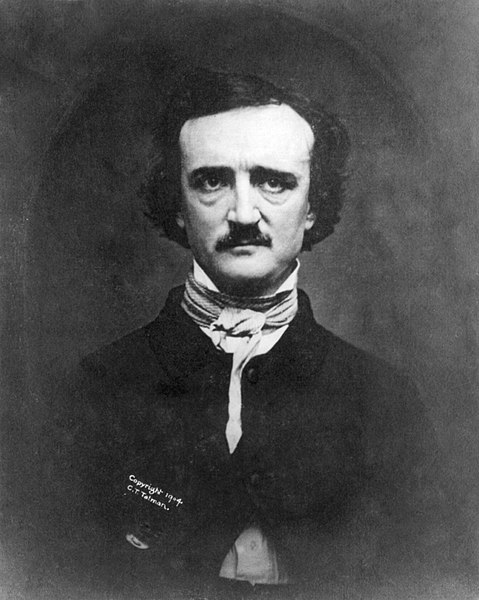
'The Pit and the Pendulum' is of course a short narrative by Edgar Allan Poe whose ostensible subject is the imprisonment and torture of a victim of the Inquisition.
It is also an interesting observation about food, drink, sustenance, and madness.
Several times does the protagonist tell us of the bread and water left for him by his jailers. The water pitcher itself becomes nearly a character in its own right -- symbolizing both our captive's sustenance as well as a ubiquitous reminder of 'civilization' and its discontents.
Starvation, the protagonist observes, may not be the worst sort of death: 'Was I left to perish of starvation in this subterranean world of darkness; or what fate perhaps even more fearful awaited me?' But Poe is smarter than that. He realizes that however terrifying the pit or the steel pendulum, death by either would be quick and perfect. Whereas death by starvation is miserable in the worst and most elongated way. Poe even plays with our sensibility by having his narrator state: 'Neither could I forget what I had read of these pits -- that the SUDDEN extinction of life formed no part of their most horrible plan'.
Of course, the Pit is nothing compared to the starvation the narrator would face eluding the Pit.
And Poe ups the ante by removing the pitcher from the equation just moments before introducing the Pendulum; and here, in his own macabre way, Poe gives the captive both the best line from the point of view of comedy and the most foreboding line from the point of view of terror: 'I saw to my horror that the pitcher had been removed . I say to my horror, for I was consumed with intolerable thirst. This thirst it appeared to be the design of my persecutors to stimulate, for the food in the dish was meat pungently seasoned.'
What a way to go! Death by pungent seasoning!
Well, with that in mind, let's take a quick look at two of the greatest seasonings known to humankind: Montreal Steak Seasoning and Old Bay.
Montreal Steak Seasoning is a harsh blend usually comprised of coriander, black pepper, salt, paprika, dill, red pepper, and garlic and onion. Despite its name, it can be put to excellent use in vegetarian cooking -- especially when dashed on buttery mashed potatoes or when used to sauté asparagus. The flavor is heavy on timber but the paprika and salt makes sure it's dry and rocky enough to stay put and out of the way of the natural juices or oils of whatever you are cooking. That's why I especially like it for sautés. One of my favorite mutt-meals is Seitan sautéed in Montreal Steak Seasoning and Olive Oil, then served with Saag Paneer and fresh sliced tomatoes.
Old Bay is simply the finest seasoning in the world. I wouldn't mind being tortured with Old Bay whatsoever.
Most commonly used to suffocate blue crabs and shrimp, Old Bay likewise works wonders in vegetarian meals. It's blend of mustard seed, bay leaf, celery salt, pepper, small insects, and whatever else crawled into the pot works perfectly as a topping for potatoes, corn on the cob, and even spinach. But I've got a real soft spot for Old Bay and vinegar on big ol' steak fries. This is the stuff of dreams.
So there. From a macabre Inquisition dungeon to Baltimore's Lexington Market in one fell swoop. Thanks, Mr. Poe.
24 July 2007
Politics and Food: the CNN / YouTube Debate
"What the mass media offers is not popular art, but entertainment which is intended to be consumed like food, forgotten, and replaced by a new dish." -- W.H. Auden
More than ever.
I watched the CNN/YouTube debate last night, and the similarities between it and the nation's fast-food were more than canny. First of all, by means of format, the fact that the questions in the debate came from 'average citizens' obscured how those questions were chosen. As I watched this infomercial-dressed-up-like-a-presidential-debate play out, I considered its likeness to the advertising put into fast-food.
Consider the 'Have it your way' campaign. Seriously now. Unless 'your way' includes the global mass production of standardized patties of cow slathered in American cheese on a stale bun, you'll probably soon come to the conclusion that you're really getting it 'their way'. You basically get to choose the condiments.
Hold the onions. There, that makes me feel in control. Makes me feel like my voice matters. I'm loving it.
Secondly, it impressed me to no end how much the nicety-patrol on Anderson Cooper's blog commended him for keeping the candidates to the thirty-second time limit set for answering questions that are purported to have reflected the feelings and fears of the common folk. Apparently CNN believes that any candidate should be able to respond serious on matters of policy and moral courage in the amount of time it takes to gulp a 64oz Mountain Dew.
Lastly, let's talk about the cynicism. Watching this debate through my occasionally failing old DSL, I couldn't help but think how happy the handlers of these professional politicians must have felt to have had this opportunity fall in their lap. I mean, the ability to take part in a historically hyper-promoted candidates' debate and not have to worry about any follow-up questions or rebuttals! Amazing. Everything about this debate was designed for the soundbite (go figure, but really this was just over-the-top). He or she with the best speech-writers and campaign managers came out on top, as usual. Those candidates marginalized by this format (including some very intelligent and experienced people... you know who they are) either go for laughs or become the brunt of them. The whole thing is a sham. And we all know this.
Deep down we know that this kind of commercialization of political discourse is poison. It may taste good while it's going down, but it's gonna be Tums for dessert.
23 July 2007
The Crabs
My father was from Jersey City.
And as I recall, we'd pulled the motorhome onto a campsite in North Carolina. I must have been seven years old.
Context: I moved to Maryland around age 8 or 9 and grew up a Marylander. I've been to Baltimore Blast games, saw the Skipjacks back in the day, and learned to pick a crab long before I'd managed to master long division. Grew up on Wilkens Ave in that strange hinterland between Arbutus's Westland Gardens to the south, the Paradise 7-11 to the north, Our Lady of Victory to the east, and the Inner Loop of 695 to the west. I played on both the Arbutus and Violetville Little Leagues. Not that any of this means much to someone who isn't familiar with the little culture that comprises the land between Southwestern Blvd. and Frederick Ave., but for those of you who did or do, you know what I'm talking about. I'm a Marylander. I know crabs.
You can tell where someone is from by how they eat crabs. If they smash their crab's shell with a mallet, they aren't from Maryland (mallets are for cracking a particularly tough claw and that's it). If they can't tell the difference between a male and female before opening it up, they are not from Maryland (nature marked the belly-side of the shell for you). If they complain about the 'yellow stuff' in the crab's torso, they are not from Maryland (it's mustard and it tastes great). If they eat the lungs they are definitely not from Maryland; and if they ask you to pick their crab for them and they are either over the age of ten or don't have a baby sitting on their knee, they are not from Maryland.
All you really need to pick a crab is your fingers. A butter knife helps, but is hardly mandatory.
And it's real easy: just turn the crab over (males are better), slide a finger or the edge of a knife under the key, pull it up and the shell starts to rise, turn the crab over and break the shell back towards the eyes. Then, clear out the lungs, break in half, quarter those, remove the claws, and dig in. The best meat is the lump closest to the chest.
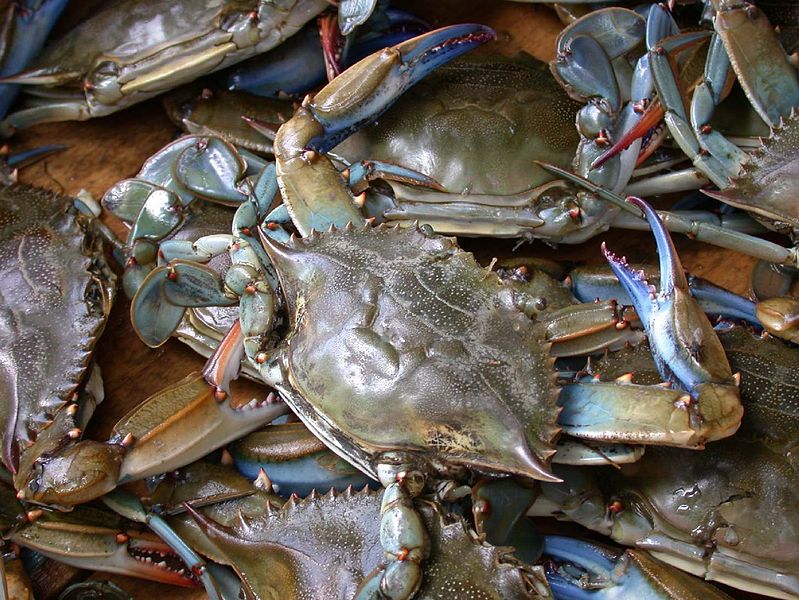
My father, mind you, was not from Maryland. He was from New Jersey. In fact, a part of New Jersey where 'crabs' meant only one thing. So I guess -- even in my pre-Maryland state -- I was both confused and excited when he came back to the motorhome with a half bushel of blue crabs.
Just the fact that we were camping in a motorhome should suggest to you a difference between the way my father and I see things. Nonetheless, I was interested in the crabs. They were alive, of course; and they began dropping out of the wet cardboard box he'd placed on the picnic table.
I know that my father had never in his life prepared crabs.
The proper way to prepare a blue crab is to steam it covered with a nice layer of Old Bay seasoning. You throw the crab in alive and blue, it comes out cooked and red. Easy.
My father, however hadn't bother to read the directions.
Which explains the grill.
Yes. The grill.
My father attempted to grill live crabs.
Everything gets a little hazy in my memory at this point, though I do remember hiding in the motorhome as my father ran around the grill cursing the crabs who'd applied themselves to his arms and fingers with their strongest Chesapeake Bay vice-grips.
Maybe the old man should have stuck to kielbasa and pirogies.
But maybe I should give him credit for at least attempting something new. I mean, who would have thought that cooking a crustacean could turn into such an amusing fiasco.
I guess I'm kinda like the old man in certain ways. Especially when it comes to either following directions or finding out the proper cooking procedure for whatever dish you happen to be preparing. Maybe that's got part to do with why I don't cook anything that could potentially attack me. It's bad enough when things get hairy with a vegetable stew.
22 July 2007
21 July 2007
Spit

When I was a kid -- as kids will do -- I used to get thirsty occasionally and I'd say to my ma, "Hey Ma, how about a drink? I'm parched over here."
To which her universal reply would be: "Swallow your spit."
Gets me thinking on a warm day like this. After all, saliva is 98% water! I mean, why go thirsty when you could just as easily carry around a cup as a spittoon?
Ok. Gross.
But there is one nutritional aspect to saliva that hardly anyone finds gross, and it has to do with the production of the bee-world's gift to humanity: honey.
Bees, of course, take nectar from the plant. This is the sweetest part of the plant's natural juices -- which is why it finds itself in the bright bloomed flowers. Bees then take the nectar home and make honeycombs, right?
Well, not exactly.
First, the bee has to put the nectar in a form which is easy to move back to the honey factory. How does he do this?
He mixes it with his own saliva.
So there you go. Next time you pour honey in your tea, just remember those bees and their spit.
Guess mom wasn't that far off.
Here's a brief and more scientific description.
20 July 2007
Mustard Obsession

Is it possible to love mustard too much?
When I first went out into the world on my own, having little scratch and less sense, I lived for a good three or four months on baked potatoes and condiments. My favorite of these condiments was mustard. So, early on in our experience of new-found freedom, in a moment of what at the time we considered great opportunity, my roommate and I left a shopping trip to a discount wholesaler with a 10 gallon barrel of yellow mustard.
I don't actually know who this 10 gallon drum was intended for. Perhaps the hot dog guy at the Yard. Perhaps a house-painter. We, however, saw this as a great investment as not only did it nightly fill us with yummy nutritious mustard, but also served as an excellent conversation piece.
The years have passed and my tastes have refined, but I still make sure the fridge is always stocked with mustard.
Today I ask your patience as I blog exotic about the greatest commercially produced mustard known to humankind:
Inglehoffer & Beaverton Stone Ground Mustard.
This mustard is so full of stony richness and brown roastiness that here I dare to type through what in ordinary circumstances would be an embarrassing damming-up of saliva and enzymes. Inglehoffer & Beaverton is sold in 4oz jars. Why only 4oz? Because a mere mortal can't handle more than 4oz of Inglehoffer & Beaverton Stone Ground Mustard in a single sitting. In fact, actually using 4oz, even among friends at a picnic, would probably result in a minor cataclysm.
4oz. Jeez, but what if you could get more?
Hmm... perhaps we could just pretend we were a HOTEL and go this route. Oh, man. Oh, man. Stop me...
Ok. I think I'm in the clear. That is until I saw this! Inglehoffer & Beaverton HONEY mustard! Could it be true?!? The greatest honey mustard known to all of NAPA valley?
I need to get myself to a mustard-tasting.
In the meantime, I'll be picking up more of it here.
19 July 2007
18 July 2007
Catfood is gross.

Catfood is gross.
The cats know this.
Sure, they'll eat it. And they might even eat a lot of it. And it is absolutely certain that if you do not give it to them, they will let you know.
But deep down inside, cats know that catfood is gross. That is the only explanation I can offer to explain why I can't eat a meal at my kitchen table without my cat jumping in my lap. Got a paw in my spaghetti this evening.
As I see it: the reason the cat wanted to eat my spaghetti is because my spaghetti is not gross. Catfood is gross. Edible, but gross.
Cats prefer raw fish. Or a bird. You never see a cat in the wild hunting for catfood.
My cat's taste for spaghetti doesn't surprise me. The first time I was in Rome, I stayed at an apartment near Villa Ado. Walking into the building I noticed little bowls of plain pasta sitting around on the curb. I figured someone had forgotten to clean up after a lunch out-of-doors. No. I was wrong. The pasta was for the neighborhood cats. Same cats that the locals had to brush off the hoods of their cars in the morning. Intensely well fed pasta eating cats.
That's where my cat must get it from. Somehow this love of pasta has been exported throughout the feline genepool. And now I can't eat spaghetti without getting a paw shoved in my mouth.
Damn Italian cats.
Ah! But here's a final thought. Perhaps we should treat this as an opportunity.
You get me some capital and we'll start a new brand of spaghetti-flavored catfood.
We'll call it 'Gatto Tomahto'.
I bet it'll be gross.
17 July 2007
Tom Waits Bacteria
Ok. So when I was like 19 years old, I worked at a restaurant downtown called 'Louie's'. I was a dishwasher. I was actually the worst dishwasher who has ever donned an apron. The other dishwashers used to look at me in disgust. I was terrible.
Anyway, I remember this one day. It was the morning after a bad storm that had knocked out electricity across the city. Our freezers had gone down, and so the dishwashers and the mop-guy were given the job of ridding them of hundreds of pounds of bad fish, chicken, etc.
Long story short: I'm out there by myself, 7AM on a beautiful Sunday morning carrying a forty-pound trash bag full of dead shrimp out to the dumpster. I'm the first to admit that I'm not the most muscular guy in the world (and was even worse off at 19 years old). I get the bag over my head and propped on the edge of the dumpster when the bottom of the bag falls out and I'm covered with stanky jumbos.
Anyhow, I post this video because had the sound come out of the dumpster that Waits describes, I could right then and there have truly died a happy man.
16 July 2007
Diner Days

Dwight loves diners, and he has a lot to say about our favorite aluminum-clad coffee spots. Here he is in his own words:
"Each of those thirteen diners has its own story about why I love it.
There was time I tried to get over learning about the breakup of the Smiths; there was Anne—wearing fishnet stockings—flipping off some boys who had been ogling her all evening; there was sitting alone reading a David Sedaris essay in the 'New Yorker' on my birthday; there was my first meal with my future wife, and our wedding rehearsal dinner. In none of these stories does food play much of a part, although I do remember a few of the meals: grilled cheese sandwiches and pancakes, mostly.
Several years ago I made the mistake of writing a series of grilled cheese sandwich reviews on my blog. This was only a mistake in that it got people to thinking that I really love grilled cheese sandwiches. I don’t. I like them a lot (a LOT), but mostly I just love places that serve grilled cheese sandwiches. For a long time after that every time I went to a diner I felt a sort of obligation to order grilled cheese. There are worse burdens in life, certainly, but often it meant I had to forego my 'Portobello/veggie burger rule'. This rule says that if there is a veggie burger or something with Portobello mushrooms on the menu, I give those first considerations in my ordering.
As I type that I realize how ridiculous that must sound.
How many self-respecting railroad-car diners serve Portobello-freaking-mushrooms or veggie burgers? Well, buddy, let me tell you: more than you might think. But aren’t I breaking some unwritten rule by ordering stuff so highfalutin’? Well, let me tell you another thing: unwritten rules are made to be broken.
While I prefer silver diners, and I prefer diners with jukeboxes in the booths, and I prefer diners that serve breakfast all day (and that are open 24 hours), and I especially prefer it if you can order alcohol, if everything else is just right, I’ll through those rules out the window. There is only one rule which I absolutely stand by (and have yet to have any reason not to):
Diners that have a framed poster of 'The Boulevard of Broken Dreams' on the wall all suck.
You know: that Edward Hopper homage/rip-off featuring Marilyn Monroe, Humphrey Bogart, James Dean, and Elvis Presley.
This gets at one crucial question of the diner dining experience: How much does authenticity matter, and what’s up with the 1950s obsession?
According to legend—and Wikipedia—It is generally agreed that the first diner was a horse-drawn wagon equipped to serve hot food to employees of the Providence Journal, in Providence, Rhode Island in 1872. Walter Scott who ran the diner had previously supplemented his income by selling sandwiches and coffee to his fellow pressmen at the Journal from baskets he prepared at home.
1872!
Hear that? Where exactly does Elvis Presley kitsch enter in that equation, Mr. Johnny Rockets? And did Americans stop eating French fries in 1959?
Diners—the best ones, at least—are not an emblem of some time in the past (those 'simpler times' we hear so much about); they are living, breathing, sassy waitress-employing icons of all that is great about America, land that I love."
Dwight Swanson is one of the folks responsible for 'Home Movie Day'. This project has been praised by everyone from John Waters to Martin Scorsese; do yourself a favor and check out what they are planning for this year's events. And while you are at it, pick up a copy of their new 'DVD' compilation.
15 July 2007
Dwight, the Nighthawk
Dwight Swanson collects home movies. And when I mean 'collects', I mean like has created a museum of the things (more about this tomorrow). In addition of his love of Super 8, Dwight is also quite the connoisseur when it comes to diners. Tomorrow, Dwight will ramble poetic on this love; but as a teaser, here is a list he put together of the 13 best diners in the contiguous 48.
13 Diners I have loved (in a roughly chronological order):
L.A. Diner, Boulder, CO
Denver Diner, Denver, CO
Highland Park Diner, Rochester, NY
A-1 Diner, Gardiner, ME
South Street Diner, Boston, MA
Modern Diner, Pawtucket, RI
Norm’s Diner, Groton, CT
Michigan Street Diner, Milwaukee, WI
Boulevard Diner, Dundalk, MD
Hollywood Diner, Baltimore, MD
Mayfair Diner, Philadelphia, PA
Zip’s Diner, Dayville, CT
Hollywood Diner, Dover, DE
He miss anything?
14 July 2007
Ah, beverages!

"Thought: Why does man kill? He kills for food. And not only food: frequently there must be a beverage." -- Woody Allen
The beverage is the most powerful force in the universe. The beverage has been known to help create friendship where there had been none and it has been known to destroy friendship where it had longed been assumed unassailable. It has made fortunes what they were and has torn great personages down like a rushing river through a paper dam. Water, beer, wine, cola, coffee, tea, and hard liquor: these are the names of the gods who move the world.
My thought this evening, as I'm about to retire to a good book: not only would a week without beverages be enough to kill the stoutest of men, but one could only wonder the sheer boredom faced in their absence.
Here's something to 'read' while you are enjoying a beverage of your own.
13 July 2007
Last Post About Camp Food (for a while)


From the point of view of a raccoon, we are all scraps in the end. The campfire is dead. Long live the raccoon.
12 July 2007
Cast-Iron: The Good, The Bad, and the Ugly

Ever want to run a campfire kitchen like the cowboys in those old Spaghetti Westerns?
Well you are gonna need a cast-iron frying pan. My friend Carmen lent me a copy of the world-famous Encyclopedia of Country Living by Carla Emery. If you do not have a copy, please stop reading this go straight to a bookstore and purchase or order one. I've got the ninth edition here in front of me.
Why own this book?
Name another tome that will give you detailed instructions on everything from the proper procedure for pruning fruit trees to the best practices in preparing your dead for burial.
And right there on page 34 of the ninth edition: everything you could need to know about cast-iron cookware and campfire cooking.
Here are some of the important points. I'll trust you to pick up a copy of the book for acquisition of the more salient features.
1. Never overheat cast-iron. Although it is true that if you can wield a cast-iron pan, you own death, you should be aware that your pan can crack if heated to temperatures above 300 degrees.
2. Keep cleaning to a minimum and don't use any sort of abrasive to get the job done. Cast-iron will last forever if maintained properly; get used to cleaning with a little oil and a towel.
3. If you plan to cook baked beans or roasts that are gonna take some time, you are going to have to season your pan first. This means that you'll create a seasoned coating between the food and the metal. Otherwise your pot roast may have a tangy metallic taste. Here's what you do: wash and thoroughly dry your new pan, grease the inside with a good coat of vegetable shortening (rub a bit on the outside as well), then bake the pan overnight in an oven set on low heat. Voila! In my experience, this also works for seasoning a stainless-steel wok, but you dry it on the range rather than in the oven.
My wife had a doctor who wanted her to increase her iron intake. He told her to pour tomato juice in a cast-iron pot and leave it in the fridge for a few days. The idea was that the acids in the juice somehow help the juice 'soak-up' a bit of iron from the pot. Don't know if it's true, but I wouldn't bet against it. I'm sure Spaghetti Cowboys weren't short on iron.
For more about the book, check out the 'Country Living website'.
11 July 2007
On Returning to the Bustle, Thinking of the Campfire
I'm back, and the raccoons have never had it so good.
A week at 3000 feet on a bump in the Appalachians was good for me -- mostly pleasant weather, good canoeing, and a never exasperated campfire putting the heat on a grill filled with veggies and mush. Good camping, indeed.
Let's get one thing straight right off. Camping takes many forms, but in its truest form (especially in the communal form where there's a kids' tent) it is the art of sharing -- sharing the woods with the animals that are of course more permanent residents and sharing space and food and conversation among friends and family. Even when the trip is undertaken alone, one soon senses that 'alone' is a futile notion (usually around midnight when the owl begins to call his cautious summons and the denizens of scrap-eaters wander on-site).
I'm planning on closing out this week with a couple posts about camping and eating. I think that's worth writing about. At its most essential of course, camping is really just celebrating one's ability to subside. And this gets to the heart of the matter.
Further, camping brings out something of the nomad in me. In the last thirteen years, I've had nine addresses; however I've been at the current one for the last three years. Camping gets me back out there into different surroundings and I think that's got everything to do with its appeal. MJ and I have camped from California to Massachusetts and set fires and tarnished grills all the way across this nation. The camp and the campfire represent the stops along the road where the abstract notion of space and country were superceded by the more intimate and personal acts of cooking, eating, and resting.
There is something holy about eating and sleeping and living outside of walls; and it centers around that campfire. The campfire is the hearth of the camp. It's the source of warmth on a damp morning and the source of light amidst the howls of the late-night coyotes of wilderness; it is stove and artwork and entertainment. By its presence, it teaches us that all of these things are interconnected and one; it breaks down the categories we love to encumber things with. The campfire is the most simple physical reminder of humility. Without it, we perish.
04 July 2007
The Great Outdoors Scene: The Old '96er
Here's hoping our outdoors cuisine is NOTHING like this.
I'll be back in just about a week with a post about cooking vegetarian in the Great Outdoors. 'Til then, eat well.
Subscribe to:
Posts (Atom)


